Delta Lake semantics assumed to carry over
Features like ACID MERGE patterns, schema evolution behaviors, and “read latest version” expectations create correctness drift if re-implemented implicitly.
Migration
Move Databricks workloads (Spark SQL, notebooks, Delta Lake tables, jobs, and streaming pipelines) to Snowflake with predictable conversion and verified parity. SmartMigrate makes semantic and operational differences explicit, produces reconciliation evidence you can sign off on, and gates cutover with rollback-ready criteria—so production outcomes are backed by proof, not optimism.
Quick answer
Move Databricks workloads (Spark SQL, notebooks, Delta Lake tables, jobs, and streaming pipelines) to Snowflake with predictable conversion and verified parity. SmartMigrate makes semantic and operational differences explicit, produces reconciliation evidence you can sign off on, and gates cutover with rollback-ready criteria—so production outcomes are backed by proof, not optimism.
Fit
Flow
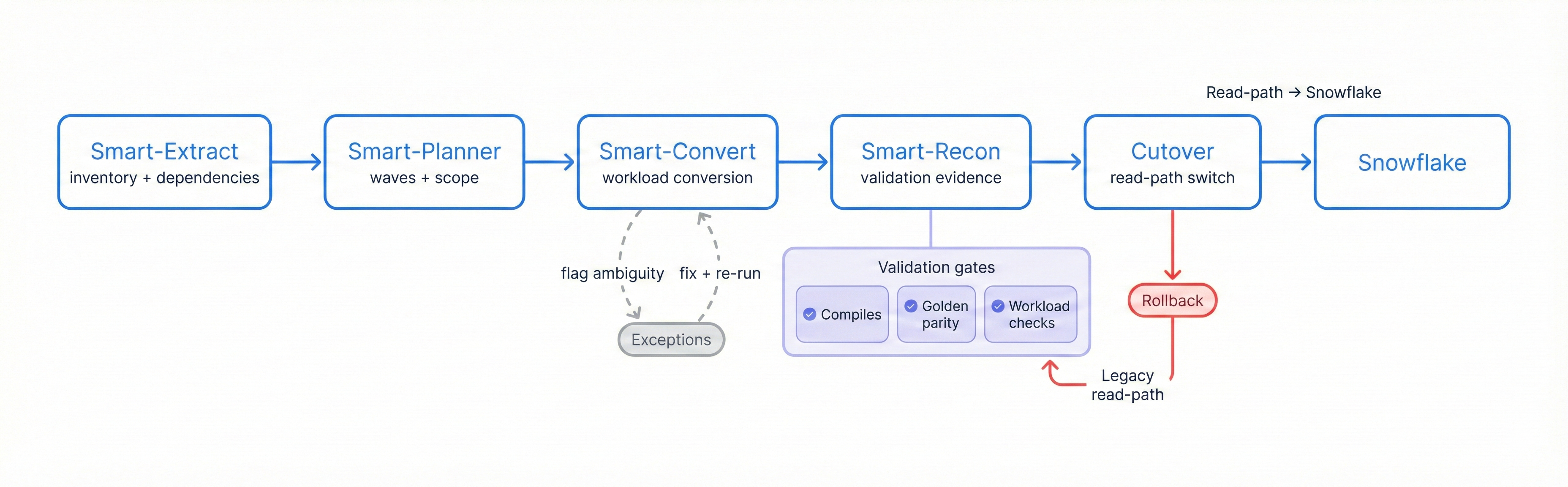
Extract → Plan → Convert → Reconcile → Cutover to Snowflake, with exception handling, validation gates, and a rollback path
Conversion
Databricks → Snowflake migration is not just “SQL translation.” It’s a platform shift: Spark’s execution model, notebooks-as-code, and Delta Lake semantics must be re-homed into Snowflake’s warehouse-centric compute model, SQL semantics, governance, and operational patterns. SmartMigrate converts what is deterministic, flags ambiguity, and structures the remaining work so engineering teams can resolve exceptions quickly. What we automate vs. what we flag:
Controls
In a Databricks → Snowflake migration, success must be measurable. We validate correctness in layers: first ensuring translated workloads compile and execute reliably, then proving outputs match expected business meaning via reconciliation. Validation is driven by pre-agreed thresholds and a defined set of golden queries and datasets. This makes sign-off objective: when reconciliation passes, cutover is controlled; when it fails, you get a precise delta report pinpointing where semantics, type mapping, incremental logic, or pipeline behavior needs adjustment. Checks included (typical set): - Row counts by table and key partitions where applicable
Optimization
Failure modes
Features like ACID MERGE patterns, schema evolution behaviors, and “read latest version” expectations create correctness drift if re-implemented implicitly.
Array/map/struct-heavy transformations translate syntactically but differ in nullability, ordering, and edge-case outputs.
Notebooks that rely on temp views, caching, implicit globals, or driver-side logic behave differently when moved into pure SQL/ELT form.
Structured Streaming jobs with stateful aggregations and watermark-based lateness handling don’t map 1:1; “near-real-time” becomes “wrong-real-time” without an explicit design.
Incremental pipelines lose dedupe/late-data correction rules, causing duplicates, missing updates, or inflated KPIs
Spark cluster costs (and job runtimes) don’t translate directly to Snowflake credits; warehouse sizing, concurrency bursts, and long-running transforms can surprise teams.
Spark’s distributed execution patterns can hide expensive reshapes. When moved to Snowflake, large intermediates and unpruned joins become slow/expensive unless query shapes are redesigned.
Unity Catalog / workspace permissions don’t map directly to Snowflake RBAC, warehouses, resource monitors, and data sharing patterns.
Do the work
Do you have signed-off golden queries/reports + thresholds (including semi-structured and time edge cases) before conversion starts?
Have you inventoried notebooks, jobs/workflows, SQL assets, libraries, and downstream consumers (BI + ML features) so nothing is “surprised” at cutover?
Have you identified where Delta features are relied on (MERGE, schema evolution, time travel expectations) and defined Snowflake equivalents?
Do you know which pipelines rely on upserts/dedupes/late-data corrections, and have you defined Snowflake patterns (staging + MERGE, idempotency rules)?
If you have streaming, have you decided how to replicate state, watermarking semantics, and operational SLOs (or re-scope to micro-batch)?
Have you cataloged UDFs, Python/Scala transforms, and custom libraries—and decided how each will be replaced (SQL, external functions, pipeline transforms, or retirement)?
Parallel run + canary gates + rollback criteria + Snowflake guardrails (credits, warehouse saturation, query latency, failure rates) are ready.
FAQ
Databricks is Spark-native and often notebook-centric, with Delta Lake semantics and flexible code-first pipelines. Snowflake is a managed warehouse with warehouse-based compute, different SQL semantics for semi-structured patterns, and operational governance centered on warehouses/RBAC/resource monitors. Migration requires re-homing execution, not just rewriting SQL.
We inventory and classify notebooks/jobs, extract deterministic SQL/DDL, identify side effects (writes, temp views, caching), and re-home pipelines into Snowflake-native patterns (ELT models, scheduled tasks, or external orchestration). Anything that remains code-heavy is treated explicitly as an implementation track—not hidden risk.
We identify where MERGE/upsert semantics and schema evolution are relied on, then design explicit Snowflake equivalents (staging + MERGE with idempotency rules, controlled schema enforcement, versioning where required). The goal is provable correctness, not “it seems to work.”
We use layered validation: compiler/execution checks, then reconciliation checks (row counts, profiling, aggregates, sampling diffs) and golden query parity. Thresholds are defined up front so correctness is measurable and auditable.
Cost is driven by credits (warehouse size × runtime), concurrency, and repeated query patterns. We analyze query shapes and job schedules, then recommend workload isolation, right-sizing, auto-suspend discipline, and (where needed) materialization/clustering so cost is predictable.
Often yes—via a parallel run window with controlled cutover gates and a rollback-ready plan. The approach depends on batch vs near-real-time pipelines, SLAs, and downstream consumer behavior. Cutover is gated by reconciliation thresholds and operational readiness.
Migration Acceleration
Get a migration plan you can execute—with validation built in. We’ll inventory your Databricks estate (notebooks, jobs/workflows, Delta tables, streaming/incremental pipelines, and custom libraries), convert representative workloads, surface risks in SQL translation and semantic mapping, and define a validation and reconciliation approach tied to your SLAs. You’ll also receive an ingestion and modeling plan, a cutover plan with rollback criteria, and performance optimization guidance for Snowflake.