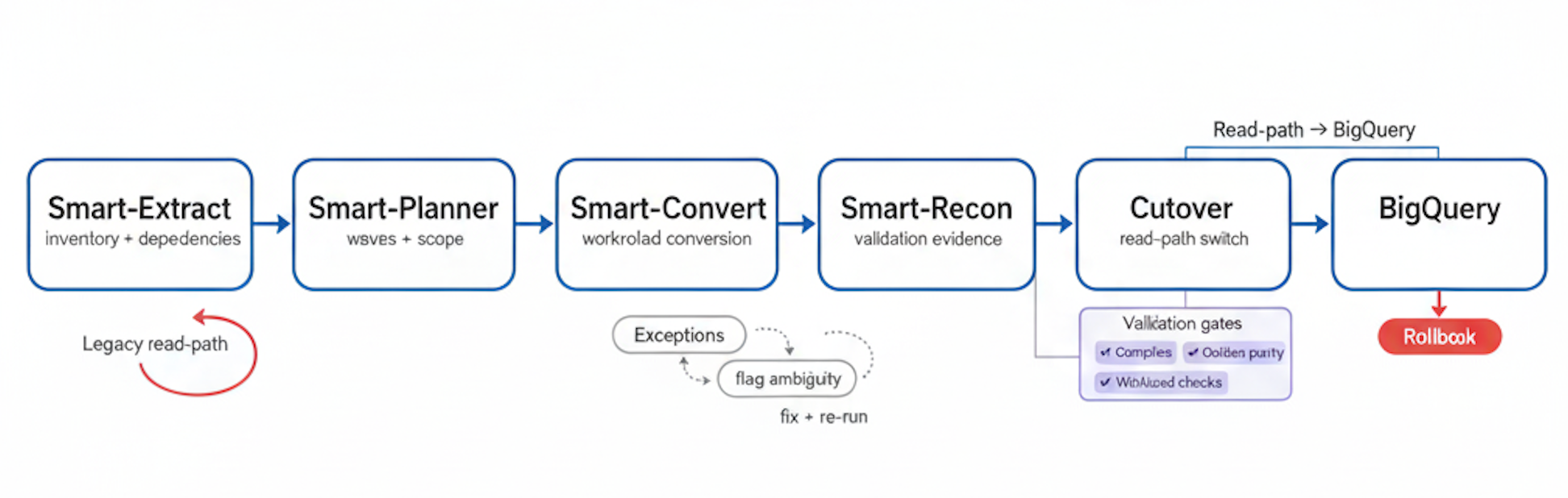
In a Redshift → BigQuery migration, success must be measurable. We validate correctness in layers: first ensuring translated workloads compile and execute reliably, then proving outputs match expected business meaning via reconciliation. Validation is driven by pre-agreed thresholds and a defined set of golden queries and datasets. This makes sign-off objective: when reconciliation passes, cutover is controlled; when it fails, you get a precise delta report that identifies where semantics, type mapping, or query logic needs adjustment. Checks included (typical set): - Row counts by table and key partitions where applicable
- Null distribution + basic profiling (min/max, distinct counts where appropriate) - Checksums/hashes for stable subsets where feasible - Aggregate comparisons by key dimensions (day, region, customer/product keys)
- Sampling diffs: top-N, edge partitions, known corner cases - Query result parity for golden queries (reports and KPI queries) - Post-cutover SLA monitoring plan (latency, bytes scanned, failure rates, concurrency/slots)