Semi-structured semantics (VARIANT / FLATTEN)
VARIANT + FLATTEN patterns don’t map 1:1 to BigQuery JSON/STRUCT/ARRAY + UNNEST. The wrong modeling choice creates either wrong results or runaway row expansion.
Migration
Move Snowflake workloads (SQL, VARIANT/JSON, Streams/Tasks, stored procedures, masking policies, and BI semantics) to BigQuery with predictable conversion and verified parity. SmartMigrate makes semantic differences explicit, produces reconciliation evidence you can sign off on, and gates cutover with rollback-ready criteria—so you don’t discover “almost correct” in production
Quick answer
Move Snowflake workloads (SQL, VARIANT/JSON, Streams/Tasks, stored procedures, masking policies, and BI semantics) to BigQuery with predictable conversion and verified parity. SmartMigrate makes semantic differences explicit, produces reconciliation evidence you can sign off on, and gates cutover with rollback-ready criteria—so you don’t discover “almost correct” in production
Fit
Risk map
These are the “gotchas” that create silent result drift, broken pipelines, or surprise cost if you don’t handle them deliberately.
VARIANT + FLATTEN patterns don’t map 1:1 to BigQuery JSON/STRUCT/ARRAY + UNNEST. The wrong modeling choice creates either wrong results or runaway row expansion.
NUMBER/DECIMAL precision, implicit casts, and timestamp/timezone handling can subtly change joins, aggregates, and KPI outputs.
A Snowflake estate isn’t “just tables + queries.” Tasks, Streams, procedures, and operational dependencies must be re-homed with an execution strategy (not deferred until the end).
RBAC, masking/row access policies, and governance controls require explicit mapping. Missing a policy is a production incident, not a rounding error.
Snowflake warehouse scaling vs BigQuery bytes-scanned + slots/reservations changes the economics of repeated BI and ELT patterns—especially when semi-structured data is involved
Dashboards can depend on rounding, ordering, NULL behavior, and time semantics that no one wrote down. If you don’t lock a “parity contract,” you will argue with the business at cutover.
Flow
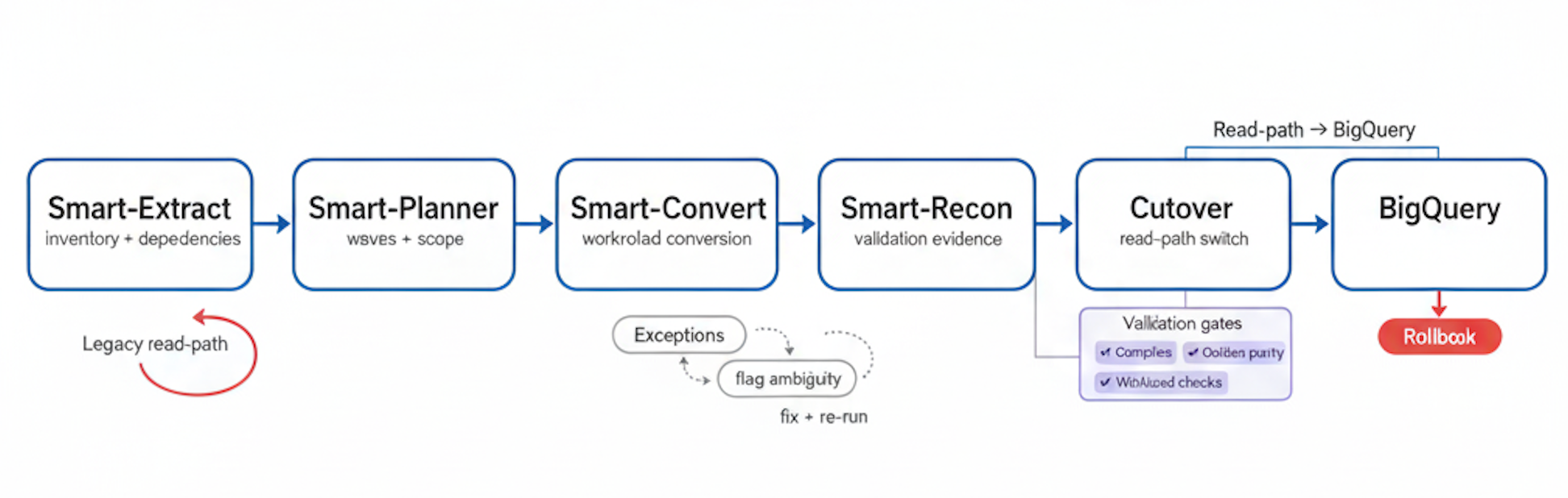
Extract → Plan → Convert → Reconcile → Cutover to BigQuery, with exception handling, validation gates, and a rollback path
Controls
In a Snowflake → BigQuery migration, success must be measurable. We validate correctness in layers: first ensuring translated workloads compile and execute reliably, then proving outputs match expected business meaning via reconciliation. Validation is driven by pre-agreed thresholds and a defined set of golden queries and datasets. This makes sign-off objective: when reconciliation passes, cutover is controlled; when it fails, you get a precise delta report that points to the cause (casting, function behavior, JSON expansion, policy parity, or procedural gaps). Checks included (typical set): - Row counts by table (and key partitions where applicable)
Optimization
Failure modes
Silent type coercions change aggregates and join matches, especially around NUMBER/DECIMAL and TIMESTAMP.
FLATTEN-to-UNNEST rewrites blow up row counts, driving cost spikes and unstable latency.
Timestamp parsing and timezone assumptions shift daily/weekly rollups and KPI cut lines.
Streams/Tasks/procedures get deferred, and critical schedules break right after cutover.
Masking/row access rules don’t translate cleanly, causing access incidents or compliance gaps.
“Same query” becomes expensive due to bytes-scanned patterns, clustering/partition misses, or repeated BI scans.
Dashboards depend on undocumented rounding/NULL/order behavior and fail parity under executive scrutiny.
Clone/time-travel driven dev/test workflows disappear, slowing delivery and increasing cutover risk.
MERGE/upsert and incremental ELT patterns behave differently, creating slowly accumulating drift.
Stage/file patterns and ingestion conventions don’t carry over, breaking pipelines and backfills.
Do the work
Do you have signed-off golden queries/reports + thresholds (including timezone + semi-structured edge cases) before conversion starts?
Do you know how VARIANT will be represented (JSON vs STRUCT/ARRAY), and how expansion will be controlled and tested?
Do you have a plan for Streams/Tasks/procedures and orchestration that preserves schedules and operational behavior?
Can you demonstrate policy equivalence (roles, masking, row/column rules) with audit-style checks?
Parallel run + canary gates + rollback criteria + BigQuery cost/perf guardrails (bytes scanned, slots, latency) are ready.
FAQ
They’re both modern warehouses, but practical differences show up in type coercion, timezone handling, semi-structured data patterns, security/policy translation, and cost/execution models. Reliable migration requires handling semantics—not just syntax.
We make type and timezone decisions explicit and normalize casting in translated queries. Precision/scale and timestamp edge cases are validated with representative datasets and golden-query comparisons to prevent silent drift.
We choose a modeling strategy (JSON vs STRUCT/ARRAY) based on access patterns and governance needs, then translate FLATTEN logic into controlled UNNEST patterns with early filters, tests, and guardrails to avoid row explosion and cost surprises.
Yes—with an explicit strategy. We inventory and classify procedural/scheduled logic, translate what’s straightforward, and re-home orchestration into the right patterns (e.g., Dataform/dbt + Composer/Workflows), aiming for operational parity, not just query parity.
Compiler/execution checks first, then reconciliation: row counts, profiles, aggregates, sampling diffs, and golden report parity with pre-agreed thresholds, producing delta reports you can audit
We analyze query shapes, expected scan patterns, concurrency, and expansion risks. We then recommend partitioning/clustering/materialization and a slot strategy, and set up monitoring to track bytes scanned and regressions.
Often yes—via a parallel run window with gated cutover and rollback criteria. The approach depends on data movement strategy (batch vs CDC), SLAs, and downstream consumer behavior.
Migration Acceleration
Get a migration plan you can execute—with validation built in. We’ll inventory your Snowflake estate (including VARIANT + Streams/Tasks/procedures + security policies), convert representative workloads, surface risks in SQL translation and modeling choices, and define a validation and reconciliation approach tied to your SLAs. You’ll also receive a cutover plan with rollback criteria and performance/cost